Europe’s borders do not begin in its south or north of the Mediterranean Sea; they are also here, on our soil. Indeed, Tunisia has become a frontline border guard for Fortress Europe, not by accident, but through calculated cooperation.
In July 2023, the Tunisian state signed an agreement with the Italian government, supported by the European Commission, intended to foster cooperation in order to strengthen border control in exchange for hundreds of millions of euros in aid. However, this money is not being used for healthcare or housing; instead, it is being used for surveillance, to control the population, for arrests, and for deportations.
Shortly before, in February 2023, the President of the Tunisian Republic, Kais Saied, launched an open attack against sub-Saharan migrants, accusing them without any evidence of being part of a “criminal conspiracy” to alter Tunisia’s demographic makeup. This conspiracy theory is not only racist but also echoes the rhetoric of the European far right, in addition to giving the green light to waves of violence.
Landlords carried out mass evictions. Police beat, arrested, and expelled migrants. Crowds drove them from their homes. Hundreds were forced into the desert, abandoned without water or food near the Libyan and Algerian borders. Several died.
Throughout Tunisia (particularly in the south and urban peripheries), refugees and immigrants from Sudan, Chad, Mali, Nigeria, and other West and Central African countries found themselves trapped. And yet, many have fled war, dictatorship, ecological collapse, or economic ruin. Most never intended to settle permanently in Tunisia. But they are trapped here, forced to live in camps, abandoned buildings, or on the streets, while the Tunisian state and the EU conspire to prevent their movement. They face police brutality, media and social incitement to hatred, racist mobs, and bureaucratic neglect.
This racism is not simply “cultural,” “accidental,” or the “product of ignorance.” It is manufactured and reinforced by the European Union and its despotic lackeys in Tunis through the state and its institutions. Thus, sub-Saharan migrants are criminalized, dehumanized, and scapegoated for all misfortunes, while their exploitation benefits the system’s masters: the landlords, bosses, and politicians. The spectacle of a “migration crisis” allows the government to mask its own failure, divert public anger from the real problems, bring the population to heel by making them accept attacks on democratic rights as “normal,” and discipline the local working class by showing them who is disposable.
But this racism isn’t only directed at the outside world. It reinforces divisions among workers and the local population, keeping us isolated and fearful while the ruling class collaborates with European governments and international institutions. We, too, are migrants. And for good reason: many Tunisians are forced into exile and are racialized and exploited to death by capitalists, landlords, and slum landlords in Europe. And now, the same structures and logic that oppress us there are the same ones we find here. It’s the same border, the same violence—simply reflected back at us like a mirror.
For our part, as libertarians and anarchists, we categorically reject these population sorting methods based on criteria such as migrant, citizen, national, foreigner, etc. These are tools of identification, hierarchy, and therefore discrimination and control. We reject the very logic that claims you need papers to live, borders to be free, or a passport to exist, and that all of this is « normal » or « natural. » Being identified, whether as a national or foreign citizen, legal or illegal, is already to be sorted and classified by the State, thus hierarchized, which we refuse. Furthermore, identification is not protection but control to ensure domination and the subjugation of the population. And as for us, libertarian socialists, we do not fight for better management of the system or borders, but for their complete abolition: capitalism, the State and its apparatus, the monetary system, and borders. Similarly, we do not campaign for inclusion in the system nor for seizing power, but to destroy them.
True solidarity is not born of pity, nor does it come from the heart or philanthropy, but rather from shared struggle. On the margins of major cities like Tunis, Sfax, Medenine, and elsewhere, we have witnessed moments of resistance with migrants and local residents fighting together, side by side, against evictions, sharing food, occupying spaces, and so on. These are not merely « humanitarian » acts, for they can be the seeds of revolutionary movements.
Against the police, the state, and the camps!
Against nationalism, patriotism, chauvinism, and racism!
For a world without states, nations, or borders on a global scale!
Freedom of migration, movement, and settlement for everyone, wherever they choose!
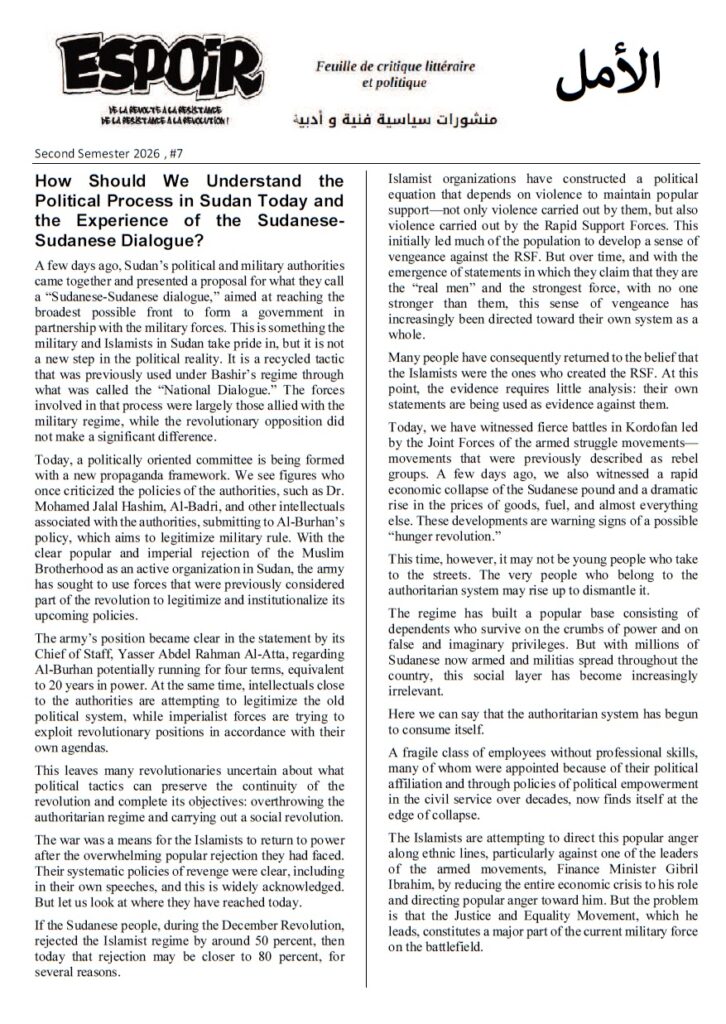
This text is excerpted from issue number seven of Al-Amal (Hope), the newsletter of the Sudanese Anarchist Collective, co-published by CNT-AIT France in collaboration with Tunisian anarchists.
To contribute to the Solidarity Fund for Sudanese Anarchists, you can use our PayPal platform: https://www.paypal.com/paypalme/cntait1 . If you prefer bank transfers, please contact us
You can also show your solidarity by sharing Al-Amal to your contacts. You can download the latest issue here: https://cnt-ait.info/wp-content/uploads/2026/10/Espoir-Al-Amal-2026-7-en.pdf
To receive the next issue by email, please send an email to at contact@cnt-ait.info